● E-Way Bill Guides · Last checked: November 2026
E-Way Bill Limit in Delhi: ₹1 Lakh, B2C Sales and NCR Trips
Blog · Published 23 November 2026 · 8 min read
Inside Delhi you need an e-way bill only when the consignment value is more than ₹1 lakh. A load worth ₹1,00,000 or less that starts and ends in Delhi can move on the invoice alone. The moment goods cross into Noida, Gurugram, Ghaziabad or any other state, the all-India figure of ₹50,000 takes over.
Delhi also has a second relaxation that most limit tables leave out. A registered business selling to an unregistered end consumer within Delhi needs no e-way bill at any value, as long as a proper tax invoice goes with the goods. The rest of this guide explains where each rule applies and where it stops.
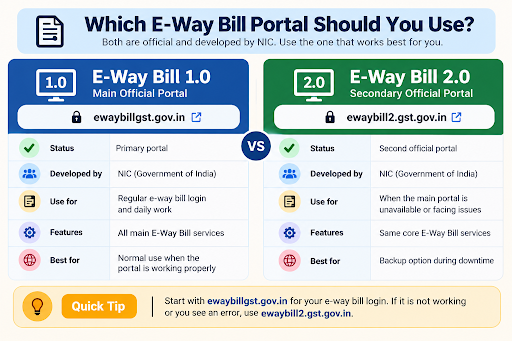
Independent guide: ewaybillinfo.com is not the government E-Way Bill or GST portal and is not connected with GSTN, NIC, CBIC or the Delhi Department of Trade and Taxes. We never ask for your password or OTP. Type them only on the official ewaybillgst.gov.in or ewaybill2.gst.gov.in sites.
Delhi rules in one table
The ₹50,000 figure comes from Rule 138 of the CGST Rules, which you can read on the CBIC e-way bill rules page. Clause (d) of Rule 138(14) lets each state relax the rule for movement inside its own borders. Delhi did this through Notification No. 3/2018 of the Department of Trade and Taxes, dated 15 June 2018 and in force from 16 June 2018. How the all-India limit works in general is on our e-way bill limit page. Here we stick to what is different in Delhi.
| Movement | No e-way bill needed when | Rule |
|---|---|---|
| Delhi to another state, or another state into Delhi | Value is ₹50,000 or less | Rule 138, CGST Rules |
| Starts and ends in Delhi, without passing through any other state | Value does not exceed ₹1,00,000 | Delhi Notification 3/2018 |
| Starts and ends in Delhi, registered business to an unregistered end consumer, with a Section 31 tax invoice | Any value | Delhi Notification 3/2018 |
| Starts and ends in Delhi, but the route passes through Haryana or Uttar Pradesh | Value is ₹50,000 or less (the Delhi relaxation does not cover this trip) | Rule 138, CGST Rules |
We could not find any later Delhi notification that changes the ₹1 lakh figure when we checked in November 2026. Before you rely on it for a large dispatch, look at the notifications section of the Delhi Department of Trade and Taxes website, since state rules can be revised.
Reading Notification 3/2018 line by line
“Does not exceed ₹1 lakh” means ₹1 lakh itself is exempt
The notification says no e-way bill is required where the consignment value “does not exceed” ₹1,00,000. So a delivery worth exactly ₹1,00,000 within Delhi is still exempt, and one worth ₹1,00,001 is not. Several sites write “above ₹1 lakh”, which comes to the same thing, but the exact wording helps when an officer and a driver disagree at a checkpoint.
Count the value with GST
Rule 138 defines consignment value as the taxable value on the invoice, bill of supply or delivery challan plus CGST, SGST or IGST and cess, leaving out exempt goods billed on the same document. A Delhi sale of ₹88,000 plus 18% GST comes to ₹1,03,840, so it needs a bill even though the base price is under ₹1 lakh. At least one popular finance site says GST is left out of the calculation. That is not what the rule says.
Paperwork still travels
The notification makes the point directly: even when a consignment is exempt, the tax invoice, bill of supply, voucher, delivery challan or bill of entry must go with the goods. An exempt load with no papers in the cabin is still a problem.
Why older articles say Delhi had no e-way bill at all
Before June 2018, Delhi issued two notifications, one from 1 February 2018 and one from 1 April 2018, that removed the e-way bill for movement of any goods within Delhi, whatever the value. Notification 3/2018 cancelled the second of these and brought in the ₹1 lakh limit from 16 June 2018. Any article that still says intra-Delhi movement needs no e-way bill is describing those few months in 2018.
Sales to unregistered customers (B2C)
The same notification exempts “all goods, irrespective of any value” when three things are true:
- The supply goes out from the registered place of business of a taxable person.
- The buyer is an unregistered end consumer.
- The movement carries an invoice issued under Section 31 of the Delhi GST Act.
This is a full exemption, not a higher limit. A Lajpat Nagar electronics shop delivering a ₹1,80,000 home theatre to a family in Dwarka does not need an e-way bill, provided the tax invoice travels with the goods. The exemption sits inside a notification about movement within Delhi, so it does not help when that same delivery goes to a customer in Faridabad.
Where people slip up
The notification says “end consumer”. An unregistered shopkeeper buying stock to sell on is not obviously an end consumer. For a sale like that above ₹1 lakh, generating the bill is the safe course. Also, a delivery challan alone does not meet the condition, because the notification asks for a Section 31 invoice.
NCR trips: where the ₹1 lakh stops
Delhi businesses move goods across the border all day, and this is where the higher limit causes the most mistakes. Noida and Ghaziabad are in Uttar Pradesh. Gurugram, Faridabad and Sonipat are in Haryana. A trip from Okhla to Noida Sector 63 may be shorter than a trip from Okhla to Narela, but it is an interstate movement, so the ₹50,000 rule applies.
The notification adds one more condition that almost no one explains. The ₹1 lakh relief covers movement “originating and terminating within the State of Delhi” and made “without passing through any other State”. If a truck picks up in one part of Delhi and drops in another, but the route goes out through Haryana or Uttar Pradesh on the way, the trip falls outside the Delhi relaxation. Treat it like any other movement and use ₹50,000 as the test.
Goods coming into Delhi follow the same logic. A ₹70,000 consignment from a Kundli supplier to your Delhi godown needs a bill, because it started in Haryana. Once the goods are unloaded, a later trip from that godown to a Delhi customer is checked against ₹1 lakh on its own.
If goods that needed a bill are caught without one, the vehicle can be detained and a penalty levied. Our e-way bill penalty guide explains what follows.
A quick check before the truck leaves
Keep these handy
- The invoice, bill of supply or delivery challan
- The buyer’s GSTIN, or a note that the buyer is unregistered
- Both addresses, and the route the driver will take
- The total value including GST
Step 1. Does either end lie outside Delhi?
If yes, the ₹50,000 rule applies and you can stop here. Noida, Ghaziabad, Gurugram and Faridabad count as outside Delhi.
Step 2. Does the route leave Delhi on the way?
If the driver will pass through Haryana or Uttar Pradesh between two Delhi points, use ₹50,000. If the whole route stays inside Delhi, go to Step 3.
Step 3. Is it a sale to an unregistered end consumer?
If you are a registered business and a Section 31 tax invoice goes with the goods, no e-way bill is needed at any value. If not, go to Step 4.
Step 4. Compare the value with ₹1 lakh
Add GST and cess to the taxable value. Up to ₹1,00,000, no bill. Above that, generate one before the vehicle moves, using our step-by-step generation guide.
You can always generate an e-way bill below the limit if a transporter or buyer asks for one. Rule 138 allows it, and the portal accepts it.
Worked examples
All values include GST.
| Consignment | Route | Rule that applies | E-way bill? |
|---|---|---|---|
| Office furniture to a company, ₹96,000 | Naraina to Connaught Place | ₹1 lakh (within Delhi) | No. Carry the invoice |
| Office furniture to a company, ₹96,000 | Naraina to Gurugram | ₹50,000 (interstate) | Yes |
| Hardware to a registered contractor, ₹1,00,000 exactly | Within Delhi | Does not exceed ₹1 lakh | No. Carry the invoice |
| Hardware to a registered contractor, ₹1,12,000 | Within Delhi | ₹1 lakh | Yes |
| Refrigerator and AC to a household, ₹1,45,000 | Karol Bagh to Rohini | B2C exemption (unregistered end consumer) | No. Carry the tax invoice |
| Same household order, ₹1,45,000 | Karol Bagh to Ghaziabad | ₹50,000 (interstate) | Yes |
| Stock to an unregistered retailer, ₹1,30,000 | Within Delhi | Buyer is not clearly an end consumer, so ₹1 lakh | Yes, to be safe |
| Raw material from a Kundli supplier, ₹70,000 | Kundli (Haryana) to Bawana | ₹50,000 (interstate) | Yes |
Rows five and six are the ones people mix up. The B2C relief is tied to movement within Delhi, so the same household order needs a bill once it crosses into Uttar Pradesh. Other states set their own figures, as our guides on the Maharashtra limit and the Rajasthan limit show, so do not assume a Delhi rule carries over.
Delhi e-way bill limit FAQs
What is the e-way bill limit in Delhi in 2026?
For movement that starts and ends in Delhi without passing through another state, no e-way bill is needed up to ₹1,00,000. For movement to or from another state, the bill is needed above ₹50,000. We found no change to Notification 3/2018 when we checked in November 2026.
Is an e-way bill needed for Delhi to Noida or Gurugram?
Yes, if the value is more than ₹50,000. Noida is in Uttar Pradesh and Gurugram is in Haryana, so these are interstate trips and the Delhi ₹1 lakh limit does not apply.
Do I need an e-way bill for a B2C delivery within Delhi?
Not if you are a registered business, the buyer is an unregistered end consumer, the goods stay within Delhi and a Section 31 tax invoice travels with them. This holds at any value.
Does a delivery challan alone cover goods below ₹1 lakh in Delhi?
For an exempt movement within Delhi, the notification accepts a tax invoice, bill of supply, voucher, delivery challan or bill of entry. The B2C exemption above ₹1 lakh is different: it needs a Section 31 invoice.
Which notification sets the Delhi e-way bill limit?
Notification No. 3/2018 of the Department of Trade and Taxes, Government of NCT of Delhi, dated 15 June 2018 (F. No. 3(163)/Policy-GST/2018/298-307), issued under Rule 138(14)(d) of the Delhi GST Rules and in force from 16 June 2018.
Found this useful? Share it with your accounts team.
Related E-Way Bill guides
Worked out which Delhi rule fits your load? These guides cover what comes next.
Compare a state
E-Way Bill Limit in Maharashtra
Maharashtra’s ₹1 lakh rule and its two 50 km exemptions.
Above ₹1 lakh
How to Generate an E-Way Bill
Fill Part A and Part B on the portal once your consignment is over the limit.
-
E-Way Bill Limit in Maharashtra: ₹1 Lakh Rule and Exemptions
Read the guide →: E-Way Bill Limit in Maharashtra: ₹1 Lakh Rule and ExemptionsMaharashtra needs an e-way bill inside the state only above ₹1 lakh, with no separate city limit, and goods going…
-

E-Way Bill Limit in Rajasthan: ₹50,000, ₹1 Lakh or ₹2 Lakh?
Read the guide →: E-Way Bill Limit in Rajasthan: ₹50,000, ₹1 Lakh or ₹2 Lakh?Rajasthan has three e-way bill limits: ₹50,000 for goods crossing the state border, ₹1 lakh within the state and ₹2…
-
How to Cancel an E-Way Bill: 24-Hour Rule and Steps
Read the guide →: How to Cancel an E-Way Bill: 24-Hour Rule and StepsCancel an e-way bill within 24 hours of generation from the login that made it: see how the clock runs,…
ewaybillinfo.com
Independent guides to E-Way Bill login, registration, generation, management, limits, penalties and latest updates. Always use the official government portal for account actions.
Guides
Official portals
© 2026 ewaybillinfo.com. All rights reserved.
Independent informational website. ewaybillinfo.com is not affiliated with, endorsed by, or operated by the Government of India, GSTN, NIC, CBIC, or the official E-Way Bill portal. Information on this site is provided for general guidance and may change as government rules, portal features, or procedures are updated. Always verify important details on the official government portal before taking action. We never ask for your E-Way Bill password, OTP, login credentials, or other sensitive account information.