● E-Way Bill Guides · Last checked: November 2026
E-Way Bill Limit in Maharashtra: ₹1 Lakh Rule and Exemptions
Blog · Published 20 November 2026 · 8 min read
In Maharashtra you need an e-way bill for goods moving inside the state only when the consignment value is more than ₹1 lakh. Up to ₹1 lakh, no bill is needed. Goods going to or coming from another state follow the all-India rule instead, so the bill is needed once the value crosses ₹50,000.
Maharashtra has no separate city limit. A delivery inside Mumbai and a delivery from Mumbai to Nagpur are judged against the same ₹1 lakh figure. Two more relaxations sit on top: textiles sent for job work and turmeric, chilli and raisins sent for job work or storage need no bill at all, whatever the value, if the trip stays within 50 km inside the state.
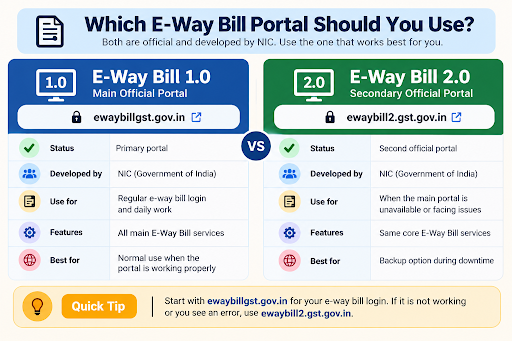
Independent guide: ewaybillinfo.com is not the government E-Way Bill or GST portal and is not connected with GSTN, NIC, CBIC or the Maharashtra GST Department. We never ask for your password or OTP. Type them only on the official ewaybillgst.gov.in or ewaybill2.gst.gov.in sites.
Maharashtra limits at a glance
The ₹50,000 figure comes from Rule 138 of the CGST Rules, and the official E-Way Bill FAQ explains it in the same terms. Rule 138(14)(d) allows each state to relax the requirement for movement that stays within its borders. Maharashtra used that power in Notification No. 15E/2018-State Tax dated 29 June 2018, and amended it on 1 October 2024. The general rules behind the ₹50,000 figure are on our e-way bill limit page; here we cover only what is different in Maharashtra.
| Movement | Goods | No e-way bill needed when | Source |
|---|---|---|---|
| Maharashtra to another state, or another state into Maharashtra | All goods | Value is ₹50,000 or less | Rule 138, CGST Rules |
| Starts and ends inside Maharashtra (any distance, including within one city) | Any goods | Value does not exceed ₹1 lakh | Notification 15E/2018-State Tax, row 1, from 1 July 2018 |
| Up to 50 km inside Maharashtra, for job work | Hank, yarn, fabric and garments | Any value | Notification 15E/2018-State Tax, row 2, from 1 July 2018 |
| Up to 50 km inside Maharashtra, for job work or for storage and warehousing | Turmeric, chilli (genus Capsicum) and raisins | Any value | Row 3, inserted by Notification 15-Eway Bill/2024-State Tax, 1 October 2024 |
We went through the Maharashtra GST Department notification list in November 2026. The only later e-way bill items there are the yearly waivers for motor vehicles moved for road testing (not by way of supply), the latest being SGST/e-way bill/01/2025-26. Nothing we found changes the ₹1 lakh figure.
How the ₹1 lakh rule works in practice
“Not exceeding ₹1 lakh” includes ₹1 lakh itself
The notification wording is “not exceeding ₹1 lakh”. A consignment worth exactly ₹1,00,000 is therefore still exempt. At ₹1,00,001 you need the bill. If you bill close to the line, round numbers matter, so check the invoice total before the truck is loaded.
The value is the invoice value with GST
Compare the limit with the consignment value as Rule 138 defines it: the taxable value on the invoice, bill of supply or delivery challan, plus the GST and cess on it. The value of exempt goods billed on the same invoice is left out. A sale of ₹90,000 plus 18% GST is ₹1,06,200, which is over the line even though the base price is not.
No separate rule for the same city
Some states give movement inside one city a higher limit. Rajasthan does this, as our Rajasthan limit guide shows. Maharashtra does not. Row 1 of the notification covers any movement that starts and ends inside the state, so Andheri to Bhiwandi, Pune city to Chakan and Nashik to Nagpur all use the same ₹1 lakh test.
No goods are carved out of the ₹1 lakh rule
Row 1 says “any goods”. Unlike some states, Maharashtra has not kept tobacco, pan masala, steel or any other item out of the higher intra-state limit.
The two 50 km exemptions
These rows are full exemptions, not a lower threshold. If your goods and purpose match, the value of the consignment does not matter.
Textiles sent for job work
Hank, yarn, fabric and garments moved up to 50 km within Maharashtra for job work, as defined in section 2(68) of the MGST Act or the CGST Act, need no e-way bill. Think of a trader in Bhiwandi sending grey fabric to a processing house 30 km away, or a garment unit sending cut pieces to a nearby stitching contractor.
Turmeric, chilli and raisins
The October 2024 amendment added turmeric, chilli (genus Capsicum) and raisins moved up to 50 km within the state for job work or for storage and warehousing. A trader taking raisins to a cold store or turmeric to a warehouse within 50 km is covered. The storage purpose is only in this row. Textiles sent to a godown, rather than for job work, do not get the 50 km exemption.
Not the same as the Part B 50 km rule
Rule 138 separately lets you leave Part B (vehicle details) blank when goods go up to 50 km within the state from your place of business to the transporter’s place for onward transport. That is a relaxation on filling the form, and you still generate the bill. The Maharashtra 50 km rows above mean no bill at all for the listed goods and purposes. Mixing the two up is a common mistake in online guides.
The notification speaks of goods “transported for the purpose of job work” and does not spell out the return trip. If processed goods worth more than ₹1 lakh are coming back from the job worker, generating a bill is the safer course. It takes a few minutes and settles any question at a checkpoint.
Decide in three steps
What you need before you start
- The invoice, bill of supply or delivery challan for the consignment
- The HSN or description of each item
- The dispatch and delivery addresses, and the road distance between them
- The reason for the movement: sale, job work, storage or something else
Step 1. Check where the goods start and end
If either end is outside Maharashtra, the ₹50,000 rule applies and you can stop here. If both ends are inside the state, go to Step 2.
Step 2. Check the 50 km rows first
If the goods are hank, yarn, fabric or garments going for job work, or turmeric, chilli or raisins going for job work or storage, and the distance is 50 km or less, no e-way bill is needed at any value. Otherwise go to Step 3.
Step 3. Compare the value with ₹1 lakh
Add GST and cess to the taxable value. Up to ₹1,00,000, no bill. Above it, generate one before the vehicle leaves, using our step-by-step generation guide.
Even when no e-way bill is needed, the driver must carry the invoice, bill of supply or delivery challan. An exempt consignment with no paperwork can still be stopped.
Worked examples
All values include GST.
| Consignment | Route | Rule that applies | E-way bill? |
|---|---|---|---|
| Electronics, ₹95,000 | Mumbai to Nagpur | ₹1 lakh (within Maharashtra) | No. Carry the invoice |
| Electronics, ₹95,000 | Mumbai to Surat | ₹50,000 (interstate) | Yes |
| Hardware, ₹1,00,000 exactly | Within Pune city | Not exceeding ₹1 lakh | No. Carry the invoice |
| Hardware, ₹1,18,000 | Within Pune city | ₹1 lakh (no separate city limit) | Yes |
| Grey fabric, ₹4,50,000 | Bhiwandi to a dyeing unit 35 km away, for job work | 50 km textile row | No. Carry the delivery challan |
| Grey fabric, ₹4,50,000 | Bhiwandi to a job worker 80 km away | ₹1 lakh (beyond 50 km) | Yes |
| Raisins, ₹6,00,000 | To a cold store 20 km away, for storage | 50 km row added in 2024 | No. Carry the delivery challan |
| Raisins, ₹6,00,000 | Sale to a buyer 20 km away | ₹1 lakh (a sale is not job work or storage) | Yes |
The last row trips people up. The 2024 row is about the purpose of the trip, not just the product. A sale of raisins is judged by the ₹1 lakh rule like any other goods.
If you are still unsure
| Situation | What to do |
|---|---|
| A transporter or buyer insists on a bill below ₹1 lakh | You can generate one. The portal accepts bills below the limit and it does no harm. |
| Goods arrive from another state and are later sent on from your Maharashtra godown | The inbound leg is interstate, so ₹50,000 applies. The later trip that starts and ends inside Maharashtra is checked against ₹1 lakh. |
| Distance for a job-work trip is close to 50 km | Use the road distance. Our PIN-to-PIN distance guide shows how to check it without login. |
| Several invoices on one truck | Each invoice is a separate consignment. Check each against the limit. |
| You find a newer notification | State rules can change. Check the Maharashtra GST Department notification list before relying on an old figure. |
If goods that needed a bill are caught without one, the vehicle can be detained and a penalty levied. Our e-way bill penalty guide explains what follows.
Maharashtra e-way bill limit FAQs
What is the e-way bill limit in Maharashtra in 2026?
For movement inside Maharashtra, no e-way bill is needed up to ₹1 lakh. For movement to or from another state, the bill is needed above ₹50,000. We checked the state notification list in November 2026 and found no change.
Is there a separate intra-city limit in Maharashtra?
No. The ₹1 lakh limit covers any movement that starts and ends inside the state, whether it is across the city or across the state.
Is ₹1 lakh counted with or without GST?
With GST. Use the taxable value plus CGST, SGST or IGST and cess on the invoice, leaving out exempt goods on the same invoice.
Do I need an e-way bill to send fabric for job work in Maharashtra?
Not if the fabric moves 50 km or less within the state for job work. Hank, yarn, fabric and garments get this exemption at any value. Beyond 50 km, the ₹1 lakh rule applies.
Which notification sets the Maharashtra e-way bill limit?
Notification No. 15E/2018-State Tax dated 29 June 2018, issued under Rule 138(14)(d) of the MGST Rules and effective from 1 July 2018. It was amended by Notification No. 15-Eway Bill/2024-State Tax dated 1 October 2024 to add turmeric, chilli and raisins.
Found this useful? Share it with your accounts team.
Related E-Way Bill guides
Know which Maharashtra rule fits your consignment? These guides cover the next step.
All of India
E-Way Bill Limit
The ₹50,000 rule, how consignment value is worked out, exemptions and validity.
Another state
E-Way Bill Limit in Rajasthan
Rajasthan’s three limits, including its ₹2 lakh same-city rule.
Above ₹1 lakh
How to Generate an E-Way Bill
Fill Part A and Part B on the portal once your consignment is over the limit.
-

E-Way Bill Limit in Rajasthan: ₹50,000, ₹1 Lakh or ₹2 Lakh?
Read the guide →: E-Way Bill Limit in Rajasthan: ₹50,000, ₹1 Lakh or ₹2 Lakh?Rajasthan has three e-way bill limits: ₹50,000 for goods crossing the state border, ₹1 lakh within the state and ₹2…
-
How to Cancel an E-Way Bill: 24-Hour Rule and Steps
Read the guide →: How to Cancel an E-Way Bill: 24-Hour Rule and StepsCancel an e-way bill within 24 hours of generation from the login that made it: see how the clock runs,…
-
E-Way Bill Extension: Time Window, Steps and Limits
Read the guide →: E-Way Bill Extension: Time Window, Steps and LimitsExtend an e-way bill in the 8-hours-before to 8-hours-after window, pick In Movement or In Transit, enter the remaining distance…
ewaybillinfo.com
Independent guides to E-Way Bill login, registration, generation, management, limits, penalties and latest updates. Always use the official government portal for account actions.
Guides
Official portals
© 2026 ewaybillinfo.com. All rights reserved.
Independent informational website. ewaybillinfo.com is not affiliated with, endorsed by, or operated by the Government of India, GSTN, NIC, CBIC, or the official E-Way Bill portal. Information on this site is provided for general guidance and may change as government rules, portal features, or procedures are updated. Always verify important details on the official government portal before taking action. We never ask for your E-Way Bill password, OTP, login credentials, or other sensitive account information.