● E-Way Bill Guides · Last checked: November 2026
E-Way Bill Limit in Rajasthan: ₹50,000, ₹1 Lakh or ₹2 Lakh?
Blog · Published 18 November 2026 · 8 min read

Rajasthan uses three different e-way bill limits, and which one applies depends on where the goods start and end. Goods going to or coming from another state need an e-way bill above ₹50,000. Goods moving between two places inside Rajasthan need one only above ₹1 lakh. Goods that start and end inside the same city need one only above ₹2 lakh.
The higher limits do not cover everything. Tobacco products and pan masala never get them, and wood and iron and steel are kept out of the ₹2 lakh city limit. The rest of this guide shows which figure fits your consignment, what “same city” means under the Rajasthan notification, and a few worked examples you can match against your own dispatches.
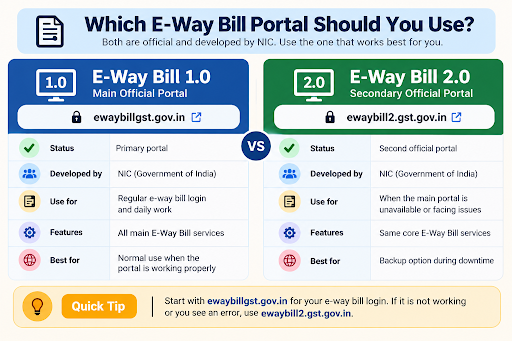
Independent guide: ewaybillinfo.com is not the government E-Way Bill or GST portal and has no link with GSTN, NIC, CBIC or the Rajasthan Commercial Taxes Department. We never ask for your password or OTP. Enter them only on the official ewaybillgst.gov.in or ewaybill2.gst.gov.in sites.
Which Rajasthan limit applies to your goods
The ₹50,000 figure comes from Rule 138 of the CGST Rules and applies across India, as the official E-Way Bill FAQ also explains. Rule 138(14)(d) lets each state relax it for movement that stays inside the state, and Rajasthan has done that twice through amendments to its e-way bill notification No. F.17(131) ACCT/GST/2017/3743 of 6 August 2018. For the general rules behind the ₹50,000 figure, see our e-way bill limit guide; this page sticks to what is different in Rajasthan.
| Type of movement | E-way bill needed when value is | Goods left out | In force from | Notification |
|---|---|---|---|---|
| Rajasthan to another state, or another state into Rajasthan | More than ₹50,000 | None (central rule) | 2018 | Rule 138, CGST Rules |
| Starts and ends inside Rajasthan, different cities or towns | More than ₹1,00,000 | Tobacco and its products (Chapter 24), pan masala (2106) | 1 April 2021 | F.17(131-Pt-II)ACCT/GST/2017/6672 |
| Starts and ends inside the same city | More than ₹2,00,000 | Tobacco (Chapter 24), pan masala (2106), wood and articles of wood (Chapter 44), iron and steel (Chapter 72) | 1 April 2022 | F.17(131-Pt.-II)ACCT/GST/2017/7713 |
“Value” here means the consignment value used for e-way bills: the taxable value on the invoice, bill of supply or delivery challan plus the GST and cess charged on it. It is not your turnover and not the value of everything loaded on the truck.
We checked in November 2026 and did not find a later Rajasthan notification that changes these figures. State notifications can be amended at short notice, so for a large or unusual consignment it is worth a quick look at the notifications section of the Rajasthan Commercial Taxes Department website.
Goods that never get the higher limits
The exclusions are written by chapter of the GST tariff, so match the HSN code on your invoice rather than going by the trade name of the product.
| Goods (HSN) | Within a city | Between cities in Rajasthan | To or from another state |
|---|---|---|---|
| Tobacco and its products, including chewing tobacco, khaini, cigarettes and bidi (Chapter 24) | Above ₹50,000 | Above ₹50,000 | Above ₹50,000 |
| Pan masala (2106) | Above ₹50,000 | Above ₹50,000 | Above ₹50,000 |
| Wood and articles of wood, such as timber and plywood (Chapter 44) | Not covered by the ₹2 lakh limit, see note below | Above ₹1,00,000 | Above ₹50,000 |
| Iron and steel, such as TMT bars, rods and sheets (Chapter 72) | Not covered by the ₹2 lakh limit, see note below | Above ₹1,00,000 | Above ₹50,000 |
| All other goods | Above ₹2,00,000 | Above ₹1,00,000 | Above ₹50,000 |
A note on wood and steel moving inside one city. The 2022 amendment only takes them out of the ₹2 lakh city entry. The 2021 entry for movement within Rajasthan does not exclude them, and a move inside one city also starts and ends within the state, so the ₹1 lakh limit is what is left on a plain reading of the two entries together. If your timber or steel consignment is between ₹50,000 and ₹1 lakh and you want to stay clear of any argument at a checkpoint, generating the bill costs you a few minutes and nothing else.
Chapter 73 (articles of iron or steel, like pipes, pipe fittings, nuts and bolts) is a different chapter from Chapter 72. Read the HSN on the invoice before deciding which row applies.
What counts as the same city
The 2022 amendment defines “city” as the municipal area notified by the state government under the Rajasthan Municipalities Act, 2009. Where a city has more than one municipal corporation, the combined notified area of all of them is treated as one city.
That definition matters more than the PIN code. A godown in an industrial area just outside the municipal boundary and a shop inside the city may share a district name, but the movement between them is not intra-city. It falls under the ₹1 lakh state limit instead.
Quick ways to settle the city question
- Check whether both addresses pay property tax or trade licence fees to the same municipal body
- Look at the municipal ward on the electricity bill or lease of each premises
- If one end is in a gram panchayat area or a separately notified industrial area, treat it as intercity
- When in doubt, use the ₹1 lakh test, not the ₹2 lakh one
Check your consignment in four steps
What you need before you start
- The invoice, bill of supply or delivery challan for the consignment
- The HSN code of each item on it
- The full dispatch and delivery addresses, including PIN codes
- Whether both addresses fall in the same municipal area
Step 1. Work out the consignment value
Take the taxable value of the goods on the document and add the GST and cess charged on it. Leave out exempt goods billed on the same invoice. Our main limit guide has a worked calculation if you want to check your arithmetic.
Step 2. Find where the goods start and end
If either end is outside Rajasthan, stop here: the ₹50,000 limit applies. If both ends are in Rajasthan, check whether they sit in the same municipal area.
Step 3. Match the HSN against the exclusions
Chapter 24 or heading 2106 means ₹50,000 whatever the route. Chapter 44 or 72 means the ₹2 lakh city limit is not available.
Step 4. Compare and act
If the value is above the limit you landed on, generate the bill before the vehicle leaves, using our guide to generating an e-way bill. If it is below, you do not need one, but the driver must still carry the invoice, bill of supply or delivery challan.
The 2021 and 2022 amendments both say the usual documents have to travel with the goods even when no e-way bill is needed. A consignment that is under the limit and has no paperwork can still be stopped.
Worked examples
All values below include GST.
| Consignment | Route | Limit that applies | E-way bill? |
|---|---|---|---|
| Readymade garments, ₹85,000 | Jaipur to Udaipur | ₹1 lakh (within Rajasthan) | No. Carry the invoice |
| Readymade garments, ₹85,000 | Jaipur to Ahmedabad | ₹50,000 (interstate) | Yes |
| Mobile phones, ₹1,60,000 | Shop to shop inside Jaipur municipal limits | ₹2 lakh (same city) | No. Carry the invoice |
| Mobile phones, ₹1,60,000 | Jaipur city to a warehouse outside the municipal limits | ₹1 lakh (within Rajasthan) | Yes |
| TMT bars (Chapter 72), ₹1,40,000 | Within Jodhpur city | ₹2 lakh not available; above ₹1 lakh in any case | Yes |
| Pan masala, ₹60,000 | Kota to Bikaner | ₹50,000 (excluded goods) | Yes |
| Spices, ₹70,000 | Delhi to Jaipur | ₹50,000 (interstate) | Yes |
The fourth row is the one that catches people. The goods never leave the Jaipur area as most people would describe it, but the destination is outside the notified municipal area, so the city limit does not apply.
Mix-ups we see most often
| What people assume | What the notifications actually say |
|---|---|
| Rajasthan has a ₹2 lakh limit for everything | ₹2 lakh is only for movement inside one city, and not for tobacco, pan masala, wood or iron and steel |
| Goods coming into Rajasthan get the ₹1 lakh limit | No. Anything crossing the state border is interstate and the ₹50,000 rule applies |
| Below the limit means no paperwork | The invoice, bill of supply or delivery challan must still travel with the goods |
| Same district means same city | The test is the notified municipal area, not the district or PIN code |
| I cannot generate a bill below the limit | You can. The portal accepts a bill for a value below the limit |
If goods that needed a bill are caught without one, the officer can detain the vehicle and levy a penalty. Our e-way bill penalty guide explains what follows and how release works.
If you do generate a bill, check the PIN codes before you submit, because the portal calculates the route distance from them. Our PIN-to-PIN distance guide covers what to do when the portal distance does not match your route.
Rajasthan e-way bill limit FAQs
Is the e-way bill limit in Rajasthan ₹1 lakh or ₹2 lakh?
Both, for different movements. ₹1 lakh applies to goods moving between places inside Rajasthan, and ₹2 lakh applies only when the goods start and end inside the same city. Movement to or from another state stays at ₹50,000.
Do I need an e-way bill to send ₹75,000 of goods from Jaipur to Delhi?
Yes. That is an interstate movement, so the Rajasthan limits do not apply and the ₹50,000 rule from Rule 138 of the CGST Rules decides it.
Does the ₹2 lakh intra-city limit cover plywood or steel?
No. The 2022 amendment leaves out wood and articles of wood (Chapter 44) and iron and steel (Chapter 72), along with tobacco and pan masala.
Can I still generate an e-way bill below the Rajasthan limit?
Yes. The portal lets you generate a bill for a lower value, and it does no harm. It can save time at a checkpoint when the officer is unsure which limit applies.
Where can I read the official Rajasthan notification?
The notifications are published by the Commercial Taxes Department, Government of Rajasthan, on rajtax.gov.in. Look for amendments to notification No. F.17(131) ACCT/GST/2017/3743 dated 6 August 2018.
Found this useful? Share it with your accounts team.
Related E-Way Bill guides
Worked out which limit applies? These guides cover what comes next.
All of India
E-Way Bill Limit
The ₹50,000 rule, how consignment value is worked out, exemptions and validity.
Above the limit
How to Generate an E-Way Bill
Fill Part A and Part B step by step once you know a bill is needed.
If you get it wrong
E-Way Bill Penalty
What happens when goods move without a valid bill, and how detention and release work.
-
E-Way Bill Limit in Maharashtra: ₹1 Lakh Rule and Exemptions
Read the guide →: E-Way Bill Limit in Maharashtra: ₹1 Lakh Rule and ExemptionsMaharashtra needs an e-way bill inside the state only above ₹1 lakh, with no separate city limit, and goods going…
-
How to Cancel an E-Way Bill: 24-Hour Rule and Steps
Read the guide →: How to Cancel an E-Way Bill: 24-Hour Rule and StepsCancel an e-way bill within 24 hours of generation from the login that made it: see how the clock runs,…
-
E-Way Bill Extension: Time Window, Steps and Limits
Read the guide →: E-Way Bill Extension: Time Window, Steps and LimitsExtend an e-way bill in the 8-hours-before to 8-hours-after window, pick In Movement or In Transit, enter the remaining distance…
ewaybillinfo.com
Independent guides to E-Way Bill login, registration, generation, management, limits, penalties and latest updates. Always use the official government portal for account actions.
Guides
Official portals
© 2026 ewaybillinfo.com. All rights reserved.
Independent informational website. ewaybillinfo.com is not affiliated with, endorsed by, or operated by the Government of India, GSTN, NIC, CBIC, or the official E-Way Bill portal. Information on this site is provided for general guidance and may change as government rules, portal features, or procedures are updated. Always verify important details on the official government portal before taking action. We never ask for your E-Way Bill password, OTP, login credentials, or other sensitive account information.